
Get answers to frequently asked questions about hearing aids, hearing loss, hearing loss treatment, and hearing protection.
Tinnitus FAQs
Tinnitus is the medical term used to describe the perception of sound when no actual external noise is present. While many refer to it as “ringing in the ear”, tinnitus can manifest in many ways including buzzing, hissing, swooshing and clicking.
Learn More About Tinnitus
The exact physical cause of tinnitus is still undetermined. However, there are many things that can cause tinnitus:
– Age
– Exposure to loud noises
– Obstructions in the ear
– Head, neck, jaw, and brain injuries
– Acute barotrauma (sudden, extreme changes in air or water pressure)
– Ototoxic medications
– Comorbid diseases and medical conditions
Unfortunately, no. As of right now, tinnitus has no known cure. But that does not mean that individuals with tinnitus must simply “learn to live with it”. There are many treatment options available.
Certain hearing aids can in fact help relieve tinnitus symptoms, especially if those symptoms are caused by hearing loss.
Shop Tinnitus Hearing Aids
If you suspect you have tinnitus, schedule an appointment at Audible Hearing Centers today. We offer FREE hearing screenings to anyone who suspects they may have tinnitus. Once diagnosed, we can create a custom treatment plan complete with tinnitus hearing aids if necessary.
Schedule an Appointment
Hearing Aid FAQs
In the simplest terms, hearing aids work like mini stereos.
First, a microphone picks up sound and converts it to an electric signal. Then, an amplifier increases the signal’s strength before converting it back to a sound. And last, a speaker emits the sound into the inner ear for the brain to receive and process.
In newer AI hearing aids, the signal can be manipulated and improved for even better sound quality.
Yes. There are several different types of hearing aids designed to treat the varying degrees of hearing loss while meeting your lifestyle needs. The two major types are: 1) over-the-ear, and 2) in-the-ear.
Over-the-ear hearing aids include:
– Behind-the-ear
– Receiver-in-canal
– Mini Receiver-in-canal
In-the-ear hearing aids include:
– Traditional in-the-ear
– In-the-canal
– Completely-in-canal
– Invisible
About the Different Hearing Aid Styles
Hearing aids come in two major types: in-the-ear and over-the-ear (AKA behind-the-ear).
Over-the-ear hearing aids are the most common hearing aid and are what you would expect a hearing aid to traditionally look like. Most of the device sits comfortably behind your ear.
In-the-ear hearing aids sit inside the ear. They are smaller and more discreet than their over-the-ear counterparts. However, they may not work for those with unique ear shapes.
In-the-ear vs Over-the-ear Hearing Aids
While single-sided hearing aids do exist, they are designed for individuals diagnosed with single-sided hearing loss.
However, two-ear hearing (binaural) is better than one, so we strongly suggest patients use both hearing aids as prescribed.
Single-sided Hearing Loss Hearing Aids
Choosing the right hearing aid is essential for addressing your specific hearing needs and improving your overall quality of life. This decision will be a collaborative one between you and your provider.
When crafting your unique treatment plan, your provider will present you with the hearing aid options that match your hearing needs and lifestyle. While not all hearing aid styles will be appropriate for your degree of hearing loss, your provider will be sure to give you options that fit your lifestyle, budget, and any cosmetic concerns.
As with any medical device, you will need to adjust to your new hearing aids. The adjustment period is temporary, and with a little patience and practice you will gradually adapt to your new hearing aids.
Audible Hearing Centers offers a complete line of hearing aids in all types and styles from industry leader, Audibel. Schedule an appointment to discover what options are available to you.
Schedule an Appointment
Prescription hearing aids are available only from a licensed hearing aid center after a formal hearing loss diagnosis. Beware of any company that offers prescription hearing aids without a diagnosis.
However, over-the-counter (OTC) hearing aids are available for purchase online or in-store without a formal hearing loss diagnosis.
Yes. In 2022, the FDA approved the manufacturing and sale of over-the-counter (OTC) hearing aids for perceived hearing loss. These devices can be bought online and in-store without a formal diagnosis or prescription from a hearing specialist. In fact, Audible Hearing Centers carries a line of OTC hearing aids.
Shop OTC Hearing Aids
In 2022, the FDA approved the manufacturing and sale of over-the-counter (OTC) hearing aids for perceived hearing loss. OTC hearing aids differ from traditional, prescription hearing aids in the following ways:
– They do not require a formal diagnosis.
– They treat self-perceived mild-to-moderate hearing loss.
– They have limited features and settings including an FDA mandatory volume control.
– They are less expensive.
– They can only be used by individuals 18 years and older.
– They typically do not come with any fitting or post-purchase support.
Learn More About OTC Hearing Aids
Hearing aids are small, powerful, electronic devices, and do require some care when cleaning them. Make sure you use the tools that came with your hearing aids and cleaning supplies that are hearing aid safe. Check out this handy guide from Audibel.com on how to clean your hearing aids.
How to Clean Your Hearing Aids
Hearing Loss FAQs
Many things can cause hearing loss. The most common are:
– Age
– Exposure to loud noises
– Obstructions in the ear
– Head, neck, jaw, and brain injuries
– Ototoxic medication
– Comorbid diseases, infections, and medical conditions
– Birth defects and other genetic preconditions
Yes. There are several different types of hearing loss, which are categorized by the cause of the hearing loss. The three main types of hearing loss are:
– Conductive hearing loss (CHL): when sound is prevented from reaching the inner ear either due to blockage or damage to the outer or middle ear. Conductive hearing loss is sometimes reversible if the underlying cause is remedied.
– Sensorineural hearing loss (SHL): occurs when the inner ear, cochlea, or auditory nerve is damaged and therefore unable to pick up or transmit sound to your brain. Sensorineural hearing loss is the most common type of hearing loss. It is irreversible and progressive, but usually treatable..
– Mixed hearing loss: a combination of both conductive and sensorineural hearing loss.
While it’s true many people associate hearing loss and hearing aids with aging, hearing loss can occur at any age. An estimated 1 in 5 people in the United States has hearing loss.1 Recent studies also suggest that an estimated 1 billion individuals ages 12-34 years are at an increased risk of noise-induced hearing loss due to unsafe recreational listening practices.2
Hearing is much more important than people think. A 2021 study by the National Institutes of Health (NIH) found that hearing loss directly impacts mental health.3 In fact, hearing loss is considered the largest contributor to dementia of all known risk factors.4 Plus, hearing plays a vital role in our home and work life, in keeping us independent, and feeling safer.
The Dangers of Untreated Hearing Loss
Hearing loss is typically permanent. There are exceedingly rare circumstances where hearing loss may be temporary due to trauma, infection, or a medical condition. In these instances, hearing loss may be reversible if the underlying condition can be resolved. Most hearing loss is, however, treatable.
In most cases, aside from sudden sensorineural hearing loss (SSHL), hearing loss occurs gradually over time. As a result, it can be difficult to notice that you have hearing loss until it’s too late. What’s more, friends and family often learn to accommodate hearing loss—without even realizing they are doing it.
If you find the people around you tend to repeat themselves, complain that the TV volume is too loud, or you simply struggle to follow group conversations, you may want to schedule a hearing appointment.
Schedule an Appointment
Hearing Loss Prevention and Protection FAQs
Certain types of hearing loss are not preventable due to the underlying causes: age (the leading cause of hearing loss), disease, genetics, and injury.
However, hearing loss caused by exposure to loud noises (noise-induced hearing loss [NIHL]), which is the second leading cause of hearing loss, is preventable. Adopting healthy hearing habits at an early age can help prevent NIHL.
To protect your hearing from loud noises, understanding how loud is “too loud” for your ears is essential. It’s important to note however that it’s not just about how loud a sound is, but also how long you’re exposed to it. The following table outlines how long it can take specific decibel (dBA) levels to start affecting your hearing.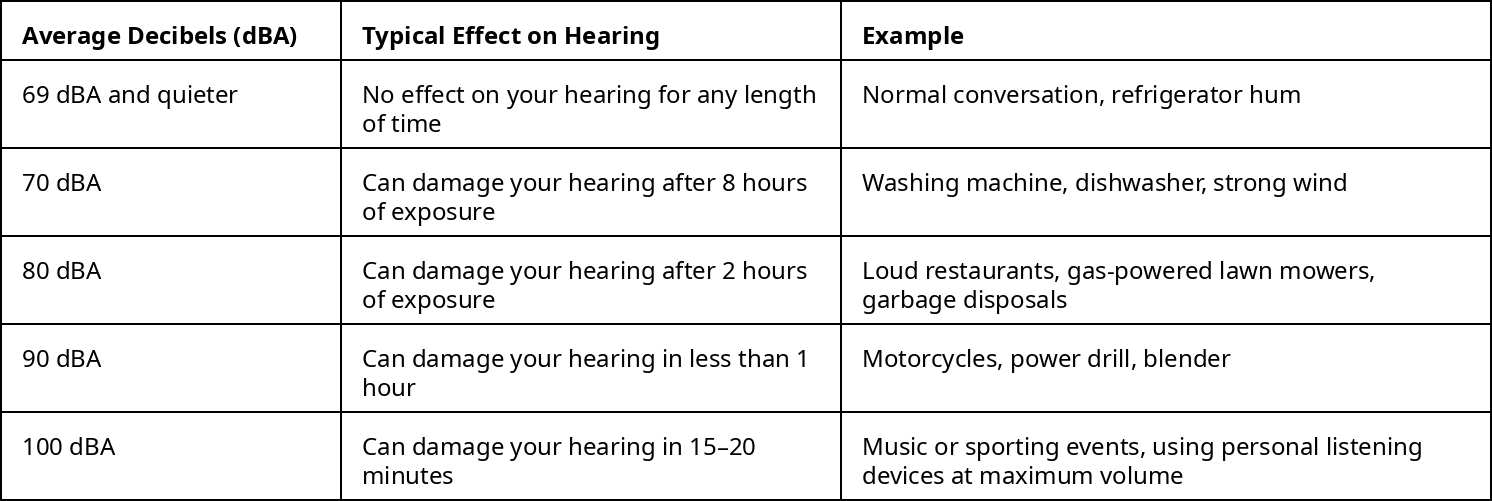
NRR stands for noise reduction rating. It is a numerical rating that represents the maximum number of decibels (dB) of hearing protection devices for which the intensity of noise can be reduced. Higher NRR values indicate greater sound reduction when they are worn correctly.
Most people associate using earplugs with keeping out unwanted noise. But hearing protection devices are important for preserving your hearing. Prolonged exposure to loud noises can cause hearing loss in as little as 8 hours. And exposure to very loud noises can cause damage in as quickly as 15 minutes.
So, you may want to consider wearing hearing protection at your next sporting event or live concert, or the next time you use power tools.
Audible Hearing Centers carries an extensive line of hearing protection from industry leader, SoundGear. We offer specialized devices for individuals who work in at-risk environments, for people who enjoy at-risk hobbies like shooting and music, and everything in between.
Shop SoundGear Hearing Protection
Hearing Services FAQs
Audiologists are healthcare professionals who have completed a Master’s, Doctor of Audiology (Au.D.), or a Ph.D. alongside extensive research who specialize in diagnosing, treating, and managing hearing and balance disorders, as well as ear problems.
Hearing aid (or hearing instrument) specialists are state-licensed hearing health professionals who are trained to evaluate hearing loss in adults and fit hearing aids.
Audible Hearing Centers offers hearing consultations, FREE hearing tests, quarterly hearing checks, annual hearing exams, hearing aid cleanings, and hearing aid repairs. That way, our professionals can be with you every step of the way from diagnosis to treatment and ongoing care.
Explore Our Hearing Services
Your first appointment will most likely be a hearing consultation. You and one of our providers will sit down to discuss everything from your hearing itself to your lifestyle and everything in between. This initial appointment is an opportunity to gain a deeper understanding of the current state of your hearing.
What to Expect at Your First Appointment
For the best hearing and ear health, it is recommended to have your hearing checked regularly even if you aren’t experiencing hearing loss symptoms.
– Infants should have their hearing checked before coming home from the hospital, or no later than one month after birth. For the best hearing and ear health, it is recommended to have your hearing checked regularly even if you aren’t experiencing hearing loss symptoms.
– Children’s hearing should be monitored frequently to ensure their hearing and communication skills are developing normally; check out this helpful checklist from the NIH.
– Adults age 50-64 years old should schedule hearing tests every five years.
– Seniors 65 and older should see a hearing specialist every one to three years to monitor their hearing.
If you’re frequently exposed to loud noises either through work or recreational activities, have health issues that can cause hearing loss, or take ototoxic medications, you may want to schedule hearing exams more frequently than advised above.
Financing FAQs
Yes. Hearing aids are FSA, HSA, and HRA eligible. You can also use FSA and HSA money for other costs related to hearing aids such as batteries, ear molds, and repairs.
Veterans’ Affairs may cover services that your VA primary care provider concludes you need to support your treatment (called ancillary services), like audiology (care for hearing loss).
Learn More About VA Health Benefits
According to the VA website, the VA can cover the cost of hearing aids.
Learn More About VA Coverage for Hearing Aids
You can learn how to apply for VA health care benefits as a veteran or service member at va.gov.
According to the Medicare website, Medicare Part B (Medical Insurance) covers diagnostic hearing and balance exams if your Medicare-enrolled doctor or health care provider orders them to find out if you need medical treatment.
You can also see an audiologist once every 12 months without an order from your health care provider, but only for:
– Non-acute hearing conditions (like hearing loss that occurs over many years)
– Diagnostic services related to hearing loss that’s treated with surgically implanted hearing devices
Learn More About Medicare Benefits
Medicare does not cover hearing aids or hearing aid fittings.
____________________
References
- Haile, L., Orji, A., Reavis, K., Briant, P. et al. (2023, Sep). Hearing Loss Prevalence, Years Lived with Disability and Hearing Aid Use in the United States from 1990 to 2019. Findings from the Global Burden of Disease Study. Ear Hear, 45(1), 257–267.
- Lauren K Dillard, Malachi Ochieng Arunda, Lucero Lopez-Perez, Ricardo X Martinez, Lucía Jiménez, Shelly Chadha. Prevalence and global estimates of unsafe listening practices in adolescents and young adults: a systematic review and meta-analysis: . BMJ Global Health;7:e010501.
- Bisogno A, Scarpa A, Di Girolamo S, De Luca P, Cassandro C, Viola P, Ricciardiello F, Greco A, Vincentiis M, Ralli M, Di Stadio A. (2021, Oct). Hearing Loss and Cognitive Impairment: Epidemiology, Common Pathophysiological Findings, and Treatment Considerations. Life (Basel);11(10):),1102. doi: 10.3390/life11101102. PMID: 34685474; PMCID: PMC8538578.
- Lin, Frank R et al.: Hearing intervention versus health education control to reduce cognitive decline in older adults with hearing loss in the USA (ACHIEVE): a multicentre, randomised controlled trial. The Lancet, Volume 402, Issue 10404, 786 -797
- Chadha,S., Dillaed, L., Marriotti, S., Keel, S. (2023, Oct). Monitoring hearing and visions functions in older adults: rationale and process. Age and Ageing (suppl 4), iv158–iv161.